
Checking Criminal History in Palmyra
No single office holds every Palmyra criminal record. The investigating agency holds its incident or arrest report. Otoe Corrections holds a booking record if the person enters the county jail. The Otoe court clerks hold filed cases. Nebraska State Patrol CID holds a person-based adult Nebraska RAP sheet when fingerprint-supported arrests and dispositions were reported.
Use this five-step route for a Palmyra search:
- Call the Otoe County Sheriff at 402-873-9560 and ask which agency responded to the Palmyra event.
- Request the incident or arrest report from that agency, using OCSO Support Services at 402-873-9563 for a sheriff report.
- Call Otoe Corrections at 402-873-9569 for current custody because its online roster is not working yet.
- Search JUSTICE under Otoe County, then contact County Court or District Court for the specific case.
- Order an NSP RAP sheet when the goal is a broader fingerprint-supported adult Nebraska history.
Do not assume the agency from the village name alone. A sheriff's deputy or State Patrol trooper may hold the record, and the correct custodian controls access.
Palmyra Police Search Does Not Exist
The official source sweep identified no Palmyra village police department, police records unit, public report portal, arrest blotter, warrant list, or police app. That negative finding is useful. It prevents a searcher from inventing a local agency or sending sensitive record details to an unrelated site.
The safe first call is OCSO Communications at 402-873-9560. Give the event date, location, and basic circumstances, then ask which agency responded. Once the investigating office is known, request the report from that office. For an OCSO record, Support Services handles the written or counter route at 1021 Central Avenue in Nebraska City.
Otoe County Sheriff
1021 Central Avenue
Nebraska City, NE 68410
402-873-9560
Confirm the responding agency
Palmyra Police Department Records
Because no official Palmyra Police Department was found, there is no local police desk whose report rules can be described. The sheriff is a contact point for identifying the responder, but that does not mean the sheriff created every report. Nebraska State Patrol may own a highway or state investigation, while the sheriff owns a deputy's incident report.
For a sheriff report, OCSO publishes a $5 incident-report fee. Active-investigation reports cannot be released. A focused written request should describe the incident date and place, involved party, and report number if known. Those details are practical aids, not official required fields from a Palmyra form, because no village police request form was identified.
Avoid the Wrong Palmyra Records
Similar place names create a real search trap. Villageofpalmyra.com belongs to Palmyra, Wisconsin, not Palmyra, Nebraska. It should not be used for Nebraska village contacts, police information, ordinances, or records requests. A polished municipal page can still be the wrong government.
Use Nebraska's official municipal directory to confirm the current Palmyra clerk contact before asking for village ordinances or minutes. For an incident report, begin with OCSO and identify the investigating agency. For a criminal case, use Otoe County in JUSTICE. State and county markers should appear on every source before personal details are submitted.
Note: The correct Palmyra record trail uses Nebraska and Otoe County identifiers, not name similarity alone.
Palmyra Arrests and Bookings
A Palmyra arrest can lead to county booking at Otoe Corrections, 1021 Central Avenue in Nebraska City. Corrections runs around the clock and can be reached at 402-873-9569. The official inmate-roster page currently says “Coming Soon.” It exposes no search controls, names, booking numbers, charges, bond fields, custody status, or release information.
Call Corrections for current county custody. If a booking record is not routinely confirmed, ask OCSO Support Services about the written public-record route. The arresting agency still owns the police narrative. A booking allegation can also differ from the charge a prosecutor files later, so compare the jail information with JUSTICE or the clerk's court file.
Who Investigated Palmyra Records
Location and context help narrow the custodian, but they do not prove it. A village incident may draw an Otoe County deputy. A traffic event may involve Nebraska State Patrol. Court execution of a warrant can add another link. Ask OCSO which agency handled the incident before paying a fee or drafting a broad request.
| Question | Best First Contact | Next Record |
|---|---|---|
| Who responded? | OCSO Communications, 402-873-9560 | Investigating agency report |
| Is the person in jail? | Otoe Corrections, 402-873-9569 | Booking or custody record |
| Were charges filed? | JUSTICE and Otoe County Court | Complaint, docket, and disposition |
| Is a broader Nebraska history needed? | Nebraska State Patrol CID | Adult fingerprint-supported RAP sheet |
This sequence avoids asking the village clerk to locate criminal records created and held by other governments.
Municipal Court Records in Palmyra
Palmyra has no municipal court. Village ordinance, traffic, misdemeanor, and preliminary felony matters run through Nebraska's County Court system. The local court is Otoe County Court, Room 109, 1021 Central Avenue, Nebraska City. Its phone is 402-873-9574, and hours are Monday through Friday from 8:00 a.m. to 4:30 p.m.
| Court Name | Otoe County Court |
|---|---|
| Case Types Heard | Palmyra ordinance, traffic, misdemeanor, and preliminary felony matters |
| Case Lookup Channel | JUSTICE online, free courthouse terminal, or clerk request |
| What the Docket Shows | Case number, offense, parties, events, orders, costs, payments, and outcome |
| Copies & Fees | Ask the clerk for a specific file, preferably with its case number |
A felony ordinarily begins in County Court. If it advances to trial-level proceedings, the case moves to Otoe District Court in Room 209. Searching both court levels prevents an early felony file from being mistaken for the complete case.
Searching Palmyra Criminal Cases
JUSTICE covers public County and District Court data from all 93 Nebraska counties. The one-time search currently costs $17, returns up to 30 cases, and keeps results available for three calendar days. New cases can lag by 24 hours. Begin with the party name and Otoe County. Add criteria only when the name alone produces too many results.
The result can show case details, trial date and outcome, subject matter, judge, parties, attorneys, costs, payments, and the register of actions. The one-time product does not include document images. Free courthouse terminals and clerk requests remain useful when an image or certified copy matters. Staff work best from a case number, though a complete party name plus year or case type may locate a specific record.
Where Palmyra Records Go
A Palmyra incident can create a three-record chain. The responder keeps the incident or arrest report. Otoe Corrections keeps any county jail intake record. County Court or District Court keeps the filed criminal case. If fingerprints are taken and submitted, Nebraska State Patrol CID can add the arrest cycle and linked disposition to its state history.
Record flow: Responding agency in Palmyra › Otoe County Courts › Nebraska State Patrol, Criminal Identification Division
A recent event is most likely to be found through the responder and Corrections. A filed case belongs in JUSTICE and at the court clerk. The state RAP sheet is better for a person-centered Nebraska history, but it omits juvenile arrests and out-of-state arrests and can miss an event without fingerprint submission.
Palmyra Warrant Record Verification
Palmyra has no official local warrant list, village police app, or public arrest blotter. A name on an old docket or private search result is not enough to prove that a warrant remains active. Court staff can help identify the Palmyra case in which a judge issued or recalled a warrant, while OCSO Communications can address the enforcement side.
Begin with the complete name and any case number. Search Otoe County in JUSTICE for the court record, then contact the issuing clerk. County Court is the likely starting point for Palmyra ordinance, traffic, misdemeanor, and early felony matters. District Court may hold a felony trial case. Ask about the status shown in the court record without assuming that a docket entry is live in every agency system.
A person resolving their own Palmyra warrant should use the official clerk and sheriff channels and follow the instructions those offices give. Do not visit an unrelated Palmyra website or rely on a third-party list. The court creates the warrant, and law enforcement executes it. That division is why both official sources may be needed for a sound Palmyra answer.
Palmyra Village or Sheriff Records
The village clerk and sheriff serve different record needs. Village minutes, ordinances, resolutions, and administrative files belong with the clerk. An OCSO incident report belongs with the sheriff. A booking belongs with Corrections. A court case belongs with the clerk of the court. No office must create a combined history by gathering the others' files.
The state auditor's interlocal filing documents Palmyra governmental relationships with Otoe County and nearby emergency-service entities. It does not prove a police-services contract. That distinction is why the sound advice remains to confirm the actual responder. An interlocal document can establish cooperation without naming the custodian of a specific criminal report.
Palmyra Records in Local Context
OR-1 School District at 425 F Street is a central Palmyra institution documented in the official Otoe juvenile plan. Its presence helps anchor a local search, but school records are not a substitute for police, court, or state criminal records. Juvenile arrests are excluded from the public Nebraska State Patrol RAP-sheet product, and juvenile court records follow special access and sealing rules.
Historical research also follows a separate track. A History Nebraska account describes an arrest and removal from a train at Palmyra during an 1875 Otoe farmers' excursion. Such an archival account can add context to family or community research, but it is not searchable through modern JUSTICE or the Nebraska State Patrol portal.
Palmyra Criminal Record Removal
Nebraska law removes some non-conviction history from public dissemination on set schedules. Public history generally stops one year after an arrest when a prosecutor files no charge, two years when nonfiling follows completed diversion, or after notice of an acquittal or qualifying dismissal. Ordinary adult conviction relief is usually a set-aside, not broad expungement.
The official Nebraska dissemination statute explains those rules.
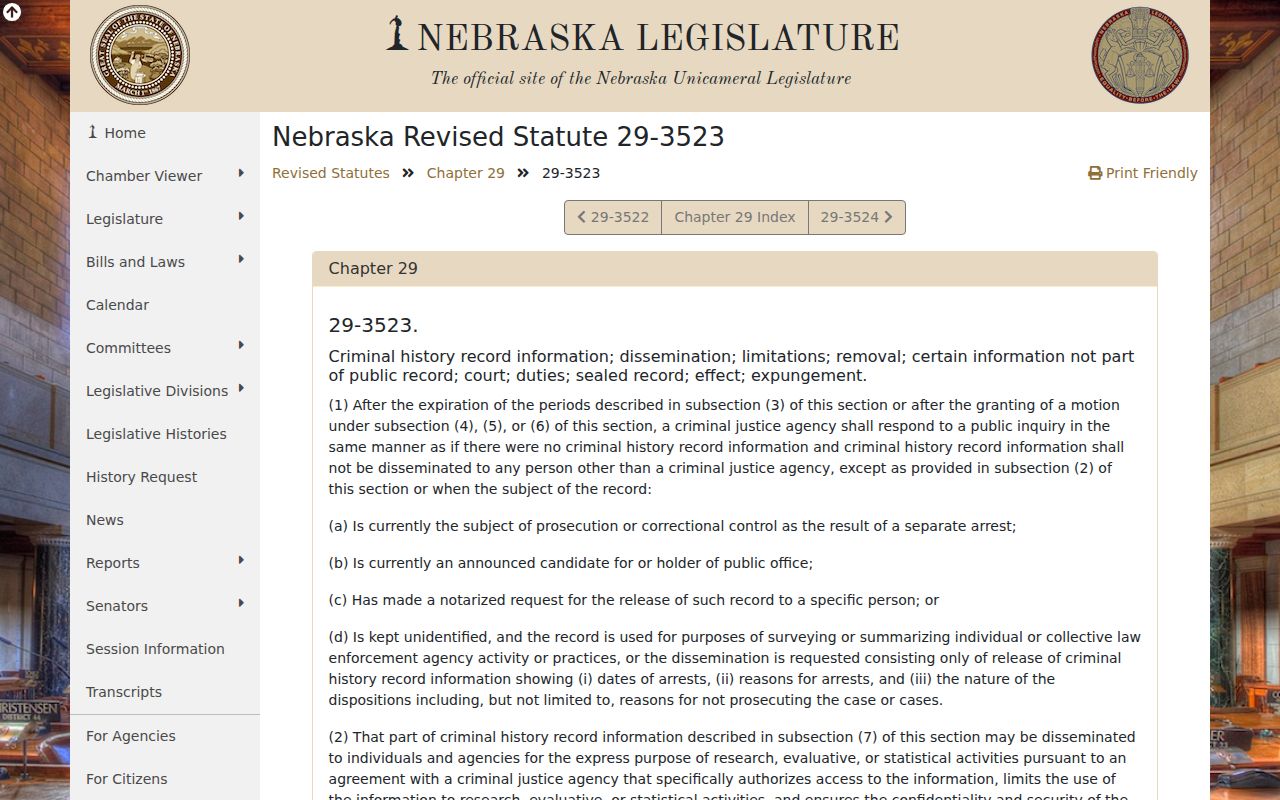
This law helps explain why an old Palmyra event may no longer appear in a public state history even when an agency once created a report.
Removal from public dissemination does not mean every source is identical. A sealed, restricted, or removed record may have different treatment at the agency, court, and state repository. A person reviewing their own Palmyra history should compare the disposition with the NSP product and use the official correction or relief process when a result is wrong.
Public Access Rules in Palmyra
Nebraska's Public Records Act provides a route to inspect and copy public records, but the request must go to the custodian. The Act does not force Palmyra, OCSO, or a court to create a new record. Investigative, personal, security, protected-victim, juvenile, sealed, and other restricted information may be withheld or redacted under the governing law and court rules.
Key Statutes:
Neb. Rev. Stat. § 84-712 supplies the inspection and copy route, cost rules, and written-response process.
Neb. Rev. Stat. § 84-712.05 permits withholding listed investigative, personal, security, and other protected records.
Neb. Rev. Stat. § 29-3523 governs dissemination and statutory removal of qualifying non-conviction history.
Nebraska Court Rules Article 8 governs electronic court access, confidentiality, and anti-bulk limits.
For a Palmyra incident, the key first step is still custodianship. Confirm the responder, ask for the specific record, and use the court or state route only for the part of the history that each one holds.